
Coaching in the Crosswinds
Dynamic Periodisation, Fast Schedules, and the Art of Staying on Course

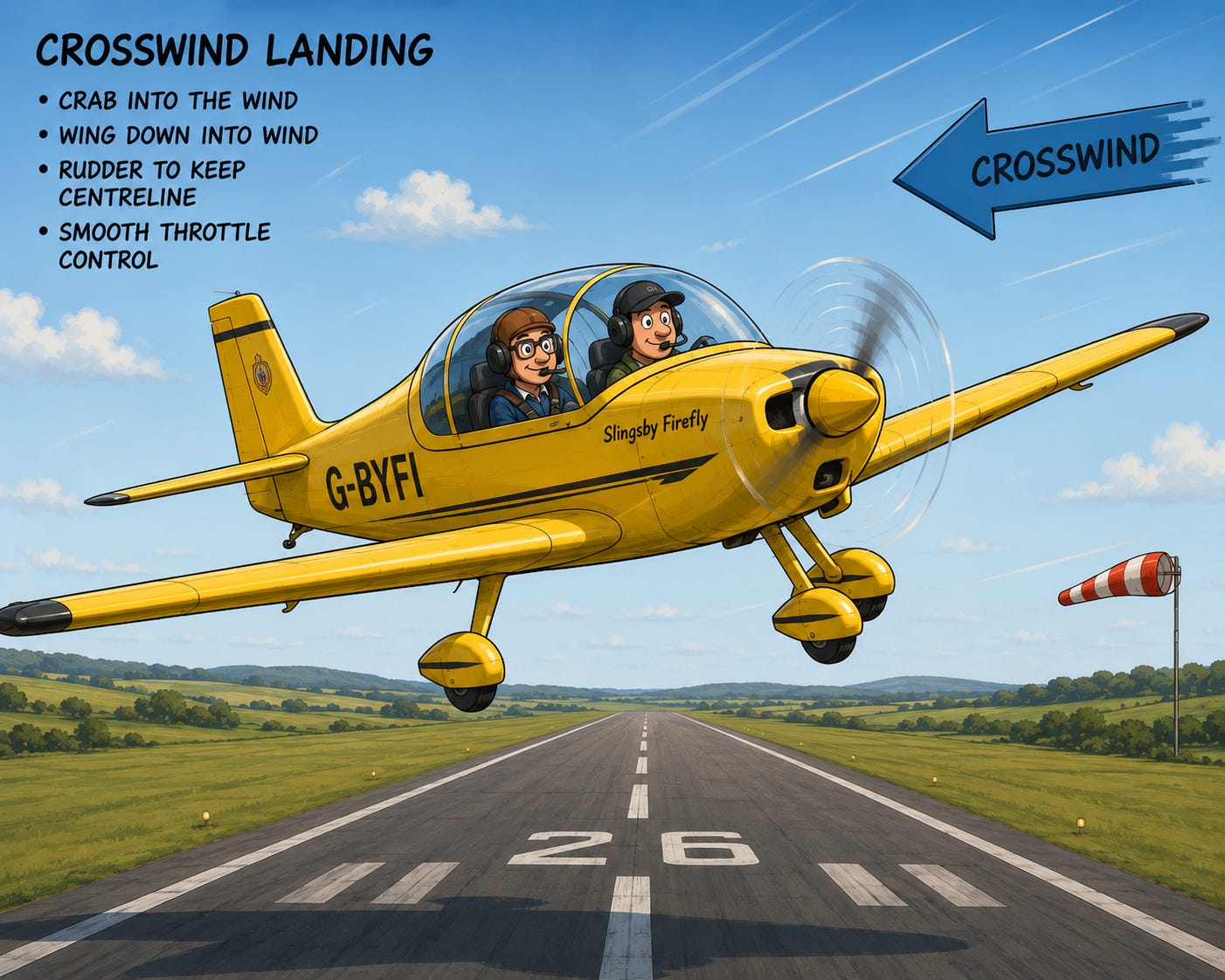
There was a conversation recently with athletes and Coaches at Paddle UK that kept replaying in my mind long after the session had finished. The athletes were talking about dealing with the crosswind — those moments when conditions suddenly shift, when the water changes beneath you, when rhythm disappears, and when stability becomes something you have to actively fight for rather than simply enjoy.
It took me back years.
As a young lad, my father occasionally took me flying in a small aeroplane. One of the things that fascinated me most was watching him land in a crosswind. It looked uncomfortable. Untidy, even. The aircraft would approach the runway slightly tilted into the wind. The rudder would kick in. The throttle would constantly adjust. Tiny corrections happened every second.
It was not smooth flying.
It was skilled flying.
Dad had to lean into instability to stay aligned with the runway.
And perhaps coaching in high-performance sport is not that different.
The Illusion of Straight-Line Performance
Many coaching plans are still built as though performance is linear. We create neat blocks, fixed progressions, carefully designed periodisation cycles, and predictable timelines. In theory, it makes sense.
But the reality of elite sport rarely behaves like a perfectly calm runway.
Competition schedules arrive thick and fast.
Travel disrupts rhythm.
Confidence fluctuates.
Fatigue accumulates.
Weather changes.
Selection pressure rises.
Recovery windows shrink.
And underneath all of it sits the invisible “crosswind” — the psychological, emotional, technical, and environmental forces constantly nudging athletes away from their intended line.
The challenge for coaches is not simply designing the plan.
The challenge is helping athletes remain adaptable when the conditions inevitably change.
Feeling the Swell Beneath the Boat
I remember a similar feeling during some recreational white-water canoeing in Spain years ago. Somebody spoke about “the swell” in the river. At the time, I had no real understanding of what they meant.
Then I felt it. Xxxx!
The boat twitched beneath me.
The current shifted unexpectedly.
My body stiffened.
My grip tightened.
All of a sudden, I became hyper-aware that forces were moving underneath the boat long before I could fully see them.
That is often what pressure feels like for athletes.
You can see it physically before you hear it verbally:
Increased tension
Rigid movement
Hesitation
Overcorrection
Emotional reactivity
Cognitive overload
The athlete is no longer simply paddling.
They are surviving the swell.
And perhaps one of the great responsibilities of coaching is not removing the swell entirely — because that is impossible — but creating environments where athletes learn how to feel it, recognise it, and adapt to it.
Creating Crosswind Conditions in Training
This raises an important question for coaches:
How do we deliberately create crosswind conditions in training without overwhelming the athlete?
Because athletes rarely fail due to a lack of capability in ideal conditions.
They struggle when instability appears unexpectedly.
So maybe part of high-performance preparation is asking:
How do we expose athletes to uncertainty?
How do we create variable conditions?
How do we train decision-making under instability?
How do we help athletes recognise when they are overcorrecting?
How do we teach them when to keep paddling and when to reset?
In aviation, pilots train repeatedly in adverse conditions because calm skies alone do not prepare them for reality.
Perhaps coaching needs similar thinking.
Not chaos for the sake of chaos.
Not random discomfort.
But carefully designed instability.
A crosswind session.
A fatigue session.
A disrupted rhythm session.
A psychologically noisy session.
Not to break confidence — but to build adaptability.
The New Challenge: Dynamic Periodisation
Another thought sitting heavily in my mind recently is the challenge of modern competition schedules.
What happens to traditional periodisation when competitions arrive every three or four weeks?
One event. Recover.
Another event. Recover.
Another event. Recover.
Where exactly is the “training phase”?
Where is the development block?
Where is the consolidation?
The old models of long uninterrupted preparation phases become harder and harder to apply in fast-moving performance environments.
Which perhaps means coaches need to think less about rigid periodisation and more about dynamic regulation.
Not simply:
“What phase are we in?”
But:
“What does the athlete need right now?”
“What is the cost of the last competition?”
“What adaptations are currently fragile?”
“Where is emotional energy?”
“What is accumulating silently?”
“What can realistically be improved between events?”
This becomes less like building a fixed annual programme and more like constant navigation.
The coach becomes less architect and more aviator.
Maintaining Performance Versus Chasing Improvement
Another difficult reality emerges in congested schedules:
You may not always be building.
Sometimes you are stabilising.
Sometimes the goal is not improvement.
It is preservation.
Maintaining technical sharpness.
Maintaining emotional stability.
Maintaining confidence.
Maintaining health.
And perhaps this requires maturity from both athlete and coach — recognising that development is rarely a permanent upward climb.
Sometimes high performance is simply:
absorbing competition,
recovering intelligently,
learning quickly,
and staying aligned long enough for another opportunity to arrive.
The Coaching Craft of Constant Adjustment
What fascinates me most is that the very best coaches often appear calm externally while internally making thousands of tiny adjustments.
Like the pilot landing in crosswinds.
Small throttle change.
Slight rudder adjustment.
Tiny shift of angle.
Not dramatic interventions.
Subtle corrections.
And maybe that is where real coaching craft exists:
sensing instability early,
adjusting before panic,
recognising when athletes are tightening emotionally,
knowing when to challenge,
knowing when to reduce load,
knowing when to stop paddling and reconnect.
Because ultimately, high-performance sport is not performed in perfect conditions.
It is performed in movement, noise, pressure, fatigue, unpredictability, and crosswinds.
And perhaps the question modern coaching increasingly has to answer is this:
How do we help athletes stay on course when the conditions refuse to stay stable?
Not just physically.
But emotionally, psychologically, technically, and relationally.
That may be one of the defining coaching challenges of modern high-performance sport.