
Context Meets Craft
Why Exceptional Coaching Begins with Sense-Making

Adapted from the original work of Professor Dave Snowden. Cynefin.
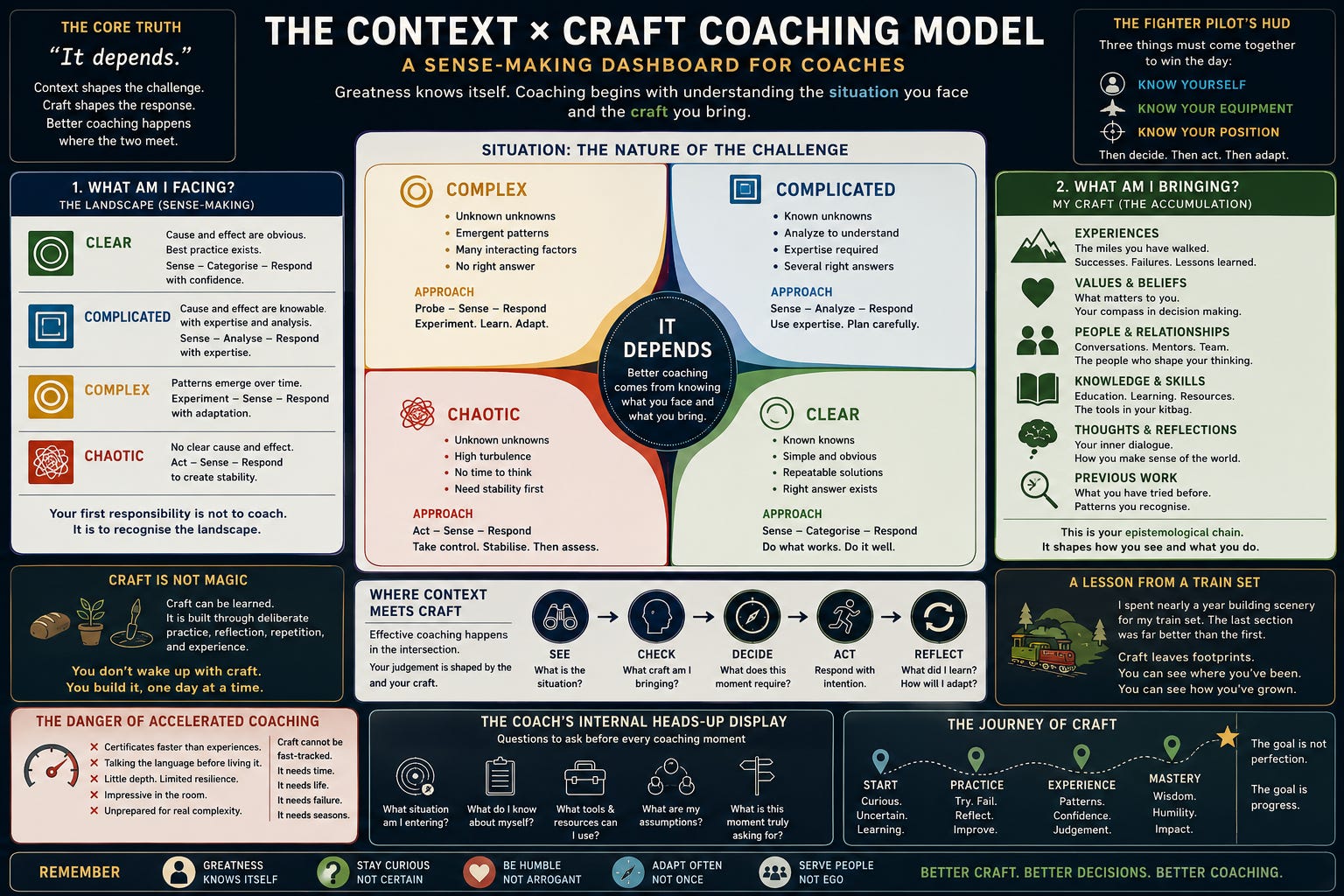
"The first responsibility of a coach is not to coach. It is to understand the situation they have entered."
One of the most liberating words in coaching is also one of the most misunderstood: it depends.
At first glance, it can sound like an evasive answer, as though the coach is unwilling to commit. Yet, in my experience, the opposite is true. The more experienced the coach, the more likely they are to begin with "it depends", because they understand that coaching is never detached from context. Every athlete, every team, every organisation and every conversation brings its own unique landscape. Before we think about what to do, we first need to understand what we are dealing with.
This is one of the reasons I continue to find myself returning to Dave Snowden's Cynefin framework. What I appreciate most is that it isn't a model for categorising people or labelling organisations. It is a framework for making sense of situations. It encourages us to pause before we act and to ask a deceptively simple question:
what kind of situation have I just walked into?
Sometimes the answer is reassuringly straightforward. Cause and effect are clear, good practice exists and experience tells us what is likely to work. At other times we find ourselves in situations that require technical expertise, careful analysis and the judgement of people who have travelled this road before. Then there are those moments where nothing appears predictable at all. Relationships, emotions and competing influences interact in ways that mean there is no obvious solution, only thoughtful experiments and continual adaptation. Occasionally, everything becomes chaotic and our first priority is simply to create enough stability for people to think clearly again.
What strikes me is that we often spend a great deal of time discussing the situation itself but far less time thinking about the person trying to make sense of it. Every coaching moment is really an intersection between two things: the context we face and the craft we bring. That relationship has become increasingly important in my own thinking.
Craft is one of those words I keep coming back to because it feels wonderfully inclusive. We sometimes speak about outstanding coaches as though they possess some mysterious gift that the rest of us simply don't have. I don't believe that. Craft is not magic and it isn't reserved for the chosen few. It is something that is built, often slowly and sometimes painfully, through deliberate practice, reflection and experience. Like any craft, it develops through repetition. We learn, we make mistakes, we adjust and we improve.
When I think about craft, my mind always wanders back to something completely unrelated to coaching. As a young boy, my dad built a train set in the loft. Once the track was laid and the trains were running, my responsibility was to create the scenery. I started in one corner, building hills, painting roads, placing trees and constructing little buildings. It became a project that lasted nearly a year.
When I finally reached the last section, I stood back and noticed something I hadn't expected. The scenery I had finished was considerably better than the scenery where I had begun. The buildings looked more realistic, the painting was more detailed and the landscapes had a depth that simply wasn't there twelve months earlier. For a moment I wondered whether I should start all over again and rebuild the first section.
Then I realised that the early work wasn't something to be embarrassed by. It was evidence. It showed me where my craft had started, while the final section showed me where my craft had grown. Without those first imperfect attempts, the later quality would never have existed.
Looking back, I realise that coaching follows exactly the same pattern. Our early sessions are rarely our finest. They are not supposed to be. They become part of our apprenticeship. Every conversation, every mistake, every athlete we misunderstand and every session that doesn't quite land becomes another layer in the craft we are slowly building. If we are paying attention, our coaching should look different five years from now than it does today.
That is why I sometimes worry about the speed at which coaching pathways now operate. We have never had greater access to knowledge. Courses, qualifications, podcasts, books, webinars and now artificial intelligence have made learning more accessible than ever before. These are all positive developments, yet there is a subtle danger if we confuse the acquisition of knowledge with the development of judgement.
It is entirely possible to progress quickly through qualifications, become fluent in contemporary coaching language and perform impressively during an interview or assessment. Experience, however, has its own timetable. Judgement cannot be downloaded. Wisdom refuses to be accelerated. Craft still asks for seasons of practice, disappointment, reflection and growth.
There is a story from a fighter pilot reflecting on aerial combat after the Second World War that has always stayed with me. He was asked what separated the very best pilots from everyone else. Was it courage? Bravery? Fearlessness? His answer was surprisingly simple. The best pilots, he said, always knew three things. They knew what they themselves were capable of. They understood exactly what their aircraft could do. And they always knew where they were within the battle. Good decisions emerged from holding those three perspectives together.
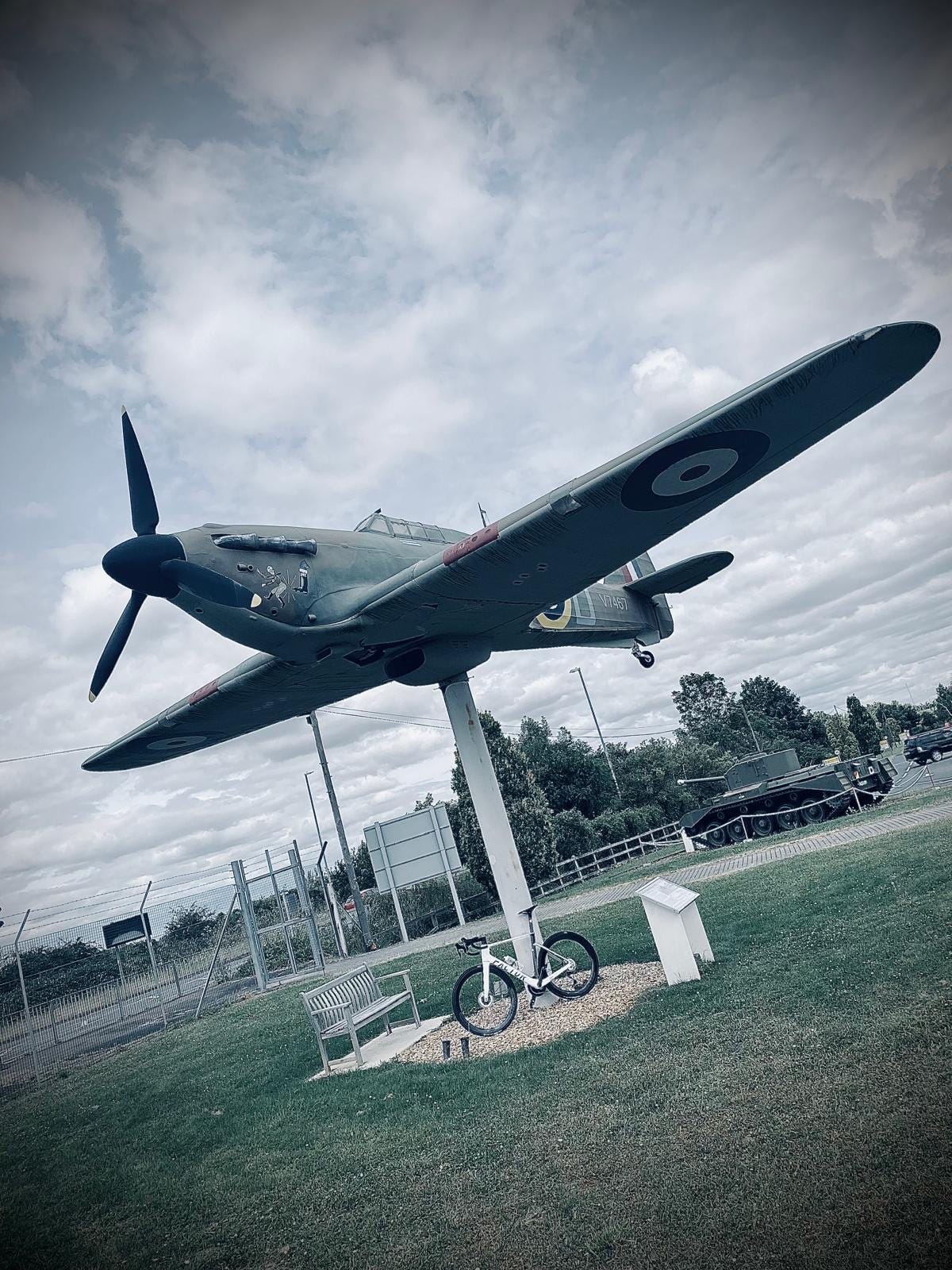
For me, that feels remarkably similar to coaching. Before every session we need our own internal heads-up display. We need to understand the situation we are entering, the people standing in front of us and the craft that we ourselves bring into the room. None of those three elements exists in isolation. They constantly interact, shaping the decisions we make and the conversations we choose to have.
Perhaps this is why the phrase "it depends" has become more meaningful to me over the years. It is no longer a sign of uncertainty. It is evidence that we have learned to pause before rushing towards an answer. It reminds us that coaching is fundamentally an act of judgement, and judgement emerges from the meeting point between context and craft.
There is a phrase I have always admired: greatness knows itself. I don't think that means believing you have all the answers. Quite the opposite. It means understanding your own strengths, recognising the limits of your experience and continuing to develop your craft with humility. The landscape will continue to change throughout our careers. New challenges will emerge and every generation of athletes will ask different questions.
Our task, therefore, is not to become coaches with all the answers. Our task is to become craftspeople—people who continue to refine their judgement, deepen their understanding and make better sense of the situations they encounter. When context meets craft, coaching becomes something richer than the application of techniques. It becomes thoughtful, adaptive and deeply human.
Perhaps that is what exceptional coaching has always been.