
Leading Across Generations: Finding the Midway

There’s a quiet advantage in growing up out of sync with your own generation.
As a child, most of my conversations didn’t happen in playgrounds or classrooms. They happened in living rooms, around tables, and in the company of people decades older than me. At ten years old, I was listening—to stories, opinions, frustrations, and reflections from people in their forties and fifties. I wasn’t just present; I was included. I could contribute, ask questions, and observe how adults made sense of the world.
At the time, I didn’t recognise it as formative. But looking back, it shaped not just how I communicate, but where I feel most at home.
Years later, I found myself working in an environment where most colleagues were in that same age bracket. And there it was again—that feeling. Not agreement. Not sameness. Something deeper. A rhythm. A tone. A way of engaging with ideas and responsibility that felt natural.
I remember saying to my wife how strange it was that I had to travel so far—geographically and professionally—to feel at home in a working environment.
That thought has stayed with me.
Because it raises a more important question:
What makes a workplace feel like “home” across generations?
And more importantly for leaders:
How do we lead people shaped by entirely different worlds?
Beyond the Labels
It’s tempting to reach for generational labels.
Millennials. Gen Z. Baby Boomers.
They offer shorthand—a way to group behaviours, expectations, and values. But they can also become a crutch. Because while trends may exist, leadership doesn’t happen in trends.
It happens in relationships.
Every individual carries a unique story—a personal “life script” shaped by their experiences, environment, and moments that mattered. For some, work represents security and stability, forged through uncertainty or responsibility. For others, it represents purpose, identity, and flexibility, shaped by a more connected and fluid world.
Neither is right. Neither is wrong.
But they are different.
And difference, if not understood, creates distance.
The Tension at the Heart of Leadership
Leaders today stand in the middle of a spectrum.
On one side sits experience—depth, loyalty, and a wealth of hard-earned knowledge.
On the other sits emergence—energy, adaptability, and a willingness to question how things have always been done.
The instinct for many leaders is to resolve this tension. To lean one way or the other.
But that misses the point.
The tension is not the problem. The tension is where the work is.
Because somewhere between those two poles is where learning lives.
The role of the leader is not to eliminate the tension, but to hold it.
The Midway Model
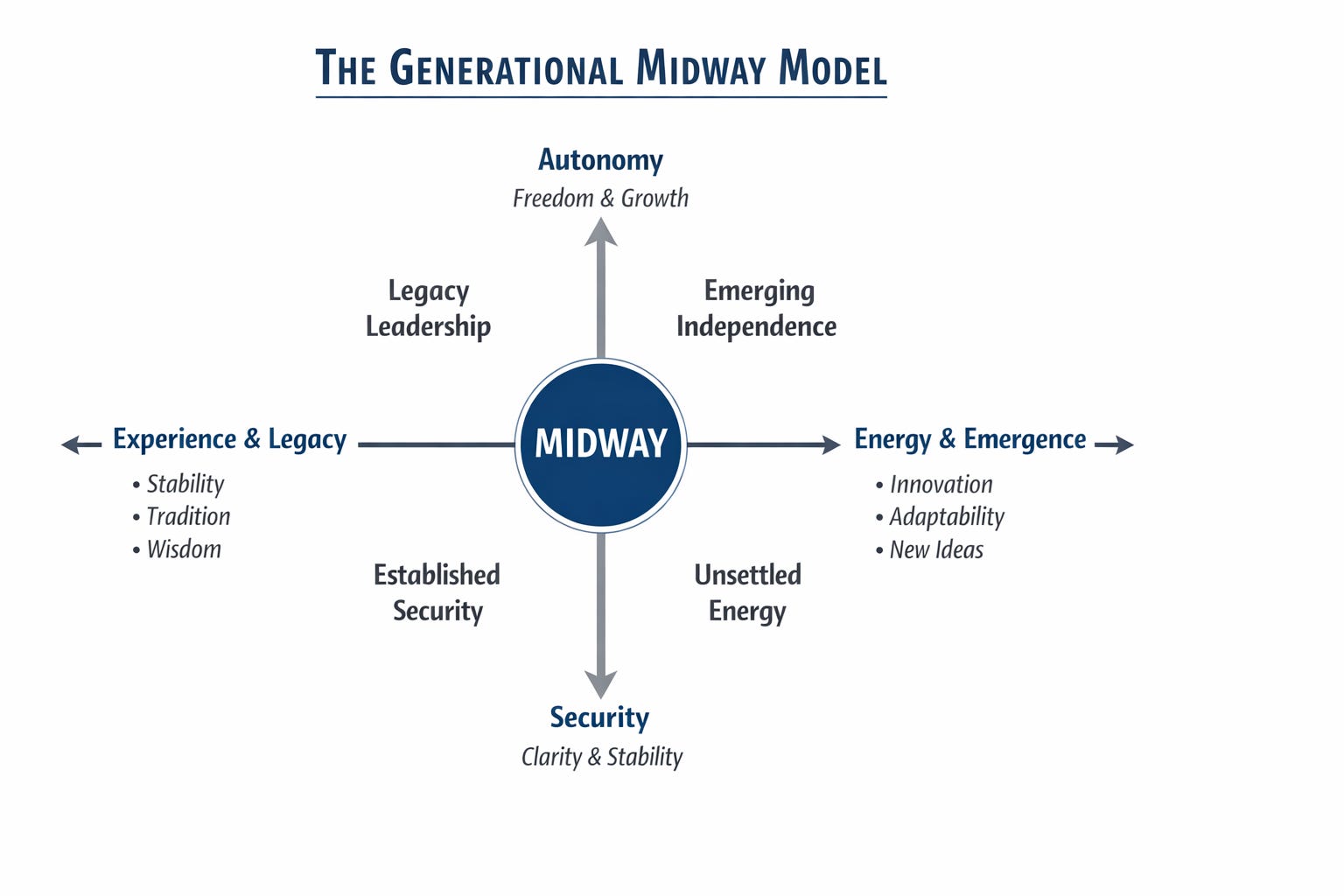
One way to think about this is through what I’ve come to see as a Midway.
Imagine a line.
On one end: experience and legacy—stability, proven methods, institutional memory.
On the other: energy and emergence—innovation, challenge, and new thinking.
Now place the leader in the middle.
Not choosing sides.
But connecting them.
Now add another dimension.
Some individuals need clarity, structure, and security. Others need freedom, voice, and autonomy.
Suddenly, leadership becomes less about control and more about navigation.
You are constantly reading the moment:
Does this person need more direction or more space?
More challenge or more support?
More context or more freedom?
The midway is not a fixed point.
It’s a practice.
The Echo We Carry
One of the most subtle challenges in leading across generations is this:
We lead how we were led.
Consciously or not, we carry forward the methods and tones that shaped us. A direct manager who got results. A supportive one who gave freedom. A demanding one who stretched us.
Those experiences become reference points.
But what worked for you may not work for them.
Not because one generation is stronger or weaker—but because the context has changed.
Expectations have changed.
The relationship with work itself has changed.
Leadership, then, is not about replication.
It’s about adaptation.

A Changing Landscape
The environments in which people have developed matter.
Some built their careers in a world where communication was slower, feedback was periodic, and hierarchy was clear.
Others have grown up in a world of immediacy—constant connection, rapid feedback, and blurred boundaries between work and life.
This shapes expectation.
A younger team member may seek regular feedback—not as reassurance, but as a way to calibrate.
A more experienced colleague may interpret that same frequency as unnecessary.
Neither is wrong.
But without awareness, both can become frustrated.
Leadership, in this space, becomes an act of translation.
Helping people understand not just what is happening—but why.
Belonging, Not Balance
That feeling of “home” I experienced in certain environments wasn’t about age.
It was about belonging.
And belonging doesn’t come from similarity.
It comes from being understood.
For leaders, this shifts the question entirely.
Not:
How do I manage different generations?
But:
How do I create an environment where each person feels seen, valued, and able to contribute?
Because when that happens, generational difference stops being a barrier—and starts becoming an asset.
Six Leadership Nudges
Rather than rigid rules, consider these as gentle calibrations.
1. Start with curiosity, not assumption Seek to understand before you seek to lead. Replace labels with questions.
2. Separate standards from style Keep expectations high, but flex how you support people to meet them.
3. Make the implicit explicit Clarify what “good” looks like. Don’t rely on unspoken rules.
4. Honour experience without being anchored to it Value what has been learned, but remain open to what is emerging.
5. Create two-way mentorship Let learning flow in both directions. Experience and fresh thinking should meet.
6. Lead the individual, not the generation Always come back to the person in front of you.
Perhaps the real challenge isn’t leading different generations.
Perhaps it’s leading difference itself.
Age is just one expression of diversity. Beneath it sits something more fundamental: perspective.
Leadership, at its best, is the ability to hold multiple perspectives without losing clarity of direction.
To create environments where experience is respected, new thinking is welcomed, and individuals feel both challenged and supported.
To recognise that while the world may change, the human need to be seen, heard, and valued does not.
That feeling of “home” I experienced was never about being surrounded by people like me.
It was about being in a place where I could contribute, learn, and belong.
And that is the challenge—and the opportunity—for leaders today.
Not to bridge generations.
But to build environments where bridging is no longer needed.