
One Brick at a Time

Winston Churchill, the Black Dog, and Why Coaches Need Something Beyond Coaching
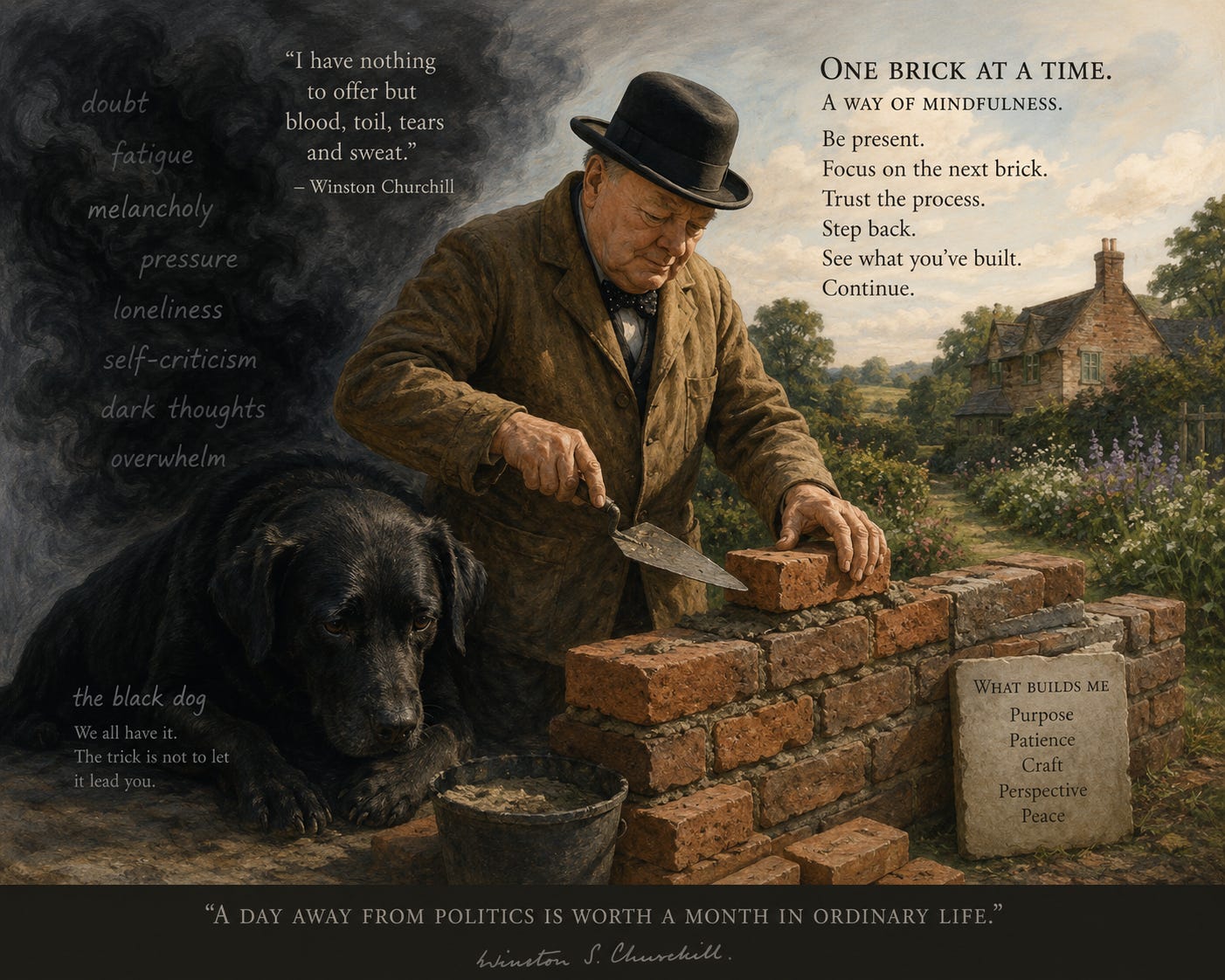
There is something strangely comforting about the image of Winston Churchill laying bricks.
Not delivering speeches.
Not debating policy.
Not standing at the centre of world events.
Just laying bricks. One at a time.
For a man whose life was dominated by pressure, responsibility, criticism, conflict, and leadership, bricklaying became more than a hobby. It became a refuge. A way of quietening the noise of the mind through the rhythm of the hands.
Churchill famously referred to periods of depression and melancholy as his “black dog.” The phrase has since become widely associated with mental struggle and emotional heaviness. Whether through painting, writing, gardening, or bricklaying, Churchill appeared instinctively drawn toward activities that grounded him in something tangible and immediate.
And perhaps that is what makes the image so powerful.
A statesman carrying bricks.
A leader mixing mortar.
A man wrestling darkness by building something slowly and carefully.
There is wisdom in that for all of us — but perhaps especially for coaches, teachers, therapists, mentors, and those who spend their lives helping other people.
Because helping people is deeply meaningful work.
But it can also become emotionally consuming work.
Living in the World of Others
Many helping professions require people to live continuously in the emotional worlds of others.
A coach absorbs:
pressure,
disappointment,
ambition,
insecurity,
frustration,
confidence,
emotional highs,
emotional crashes,
and the constant unpredictability of human behaviour.
The role becomes relational by nature.
You are constantly observing, supporting, guiding, analysing, reassuring, encouraging, challenging, and facilitating growth. Over time, you can become so focused on helping others develop that you slowly forget to maintain parts of yourself outside the role.
And this often happens quietly.
There is no dramatic collapse.
No obvious warning sign.
Just a gradual narrowing of identity.
You stop becoming a person who coaches and slowly become only “the coach.”
Your value becomes attached to usefulness.
Your worth becomes linked to contribution.
Your energy is permanently directed outward.
And eventually, many coaches begin to feel emotionally saturated without fully understanding why.
Because human development work is rewarding — but it is also psychologically expensive.
The Importance of Something Different
This is where Churchill’s bricklaying becomes symbolic.
Bricklaying had nothing to do with politics.
That was precisely the point.
It gave him something entirely different:
something physical,
something practical,
something slower,
something where progress was visible,
something that did not require emotional negotiation.
A brick does not need motivation.
A wall does not require difficult feedback conversations.
Mortar does not challenge your leadership philosophy.
You simply focus on the next brick.
And maybe that simplicity is deeply restorative.
There is a growing recognition that people in helping professions need activities outside their primary role not simply for “recovery,” but for psychological balance.
Not everything in life should involve:
performance,
emotional labour,
facilitation,
responsibility for others,
or constant self-awareness.
Sometimes the mind needs spaces where it can stop managing people altogether.
This is why hobbies matter more than we often admit.
Gardening.
Painting.
Walking.
Cycling.
Woodwork.
Fishing.
Photography.
Pottery.
Cooking.
Bricklaying.
None of these activities ask you to carry another person emotionally.
They simply ask you to be present.
Mindfulness Without Calling It Mindfulness
Interestingly, Churchill probably never described bricklaying as “mindfulness,” yet in many ways that is exactly what it became.
Modern mindfulness often speaks about:
being present,
focusing attention,
slowing mental noise,
engaging the senses,
and stepping away from constant mental rumination.
Bricklaying naturally creates many of those conditions.
You focus on the mortar.
The level of the brick.
The pressure of the trowel.
The shape of the wall.
Your mind is occupied by the task directly in front of you.
Not next month.
Not tomorrow’s meeting.
Not someone else’s emotions.
Just this brick.
Then the next one.
There is something deeply calming about repetitive, meaningful physical work. It gives the mind a place to rest without forcing it to “switch off.”
Perhaps this is why so many people find peace in simple acts of creation:
digging soil,
sanding wood,
painting walls,
baking bread,
arranging flowers,
fixing bicycles,
or tending gardens.
These activities reconnect us with process / produce rather than pressure.
And for people whose professional lives revolve around complexity, that simplicity can become essential.
Coaches Need More Than Coaching
There is sometimes an unhealthy narrative within high-performance environments that total immersion equals commitment.
The best coaches are portrayed as obsessed.
Always working.
Always analysing.
Always sacrificing.
But complete immersion can become dangerous when there is no counterbalance.
Eventually the role begins consuming the person.
Ironically, many of the most effective long-term coaches are not those who only coach.
They are people who have preserved other dimensions of themselves:
interests,
creativity,
relationships,
humour,
spirituality,
craftsmanship,
or hobbies unrelated to performance.
Not because they lack commitment.
But because they understand sustainability.
A coach who gardens may develop patience differently.
A coach who paints may rediscover creativity.
A coach who walks long distances may deepen reflection.
A coach who builds furniture may reconnect with craftsmanship and detail.
A coach who cooks may rediscover rhythm and care.
And perhaps a coach who lays bricks may rediscover the importance of slow progress.
These activities often teach indirectly what coaching sometimes tries too hard to force directly.
The Quiet Joy of Being a Beginner Again
There is another hidden gift in hobbies.
They return us to humility.
A highly experienced coach may be world-class in leadership and communication, yet completely average at painting or gardening.
And that can be healthy.
Helping professions often create invisible pressure to always appear competent, insightful, and composed. Hobbies interrupt that performance identity. They allow us to struggle harmlessly again.
There is honesty in growing vegetables badly.
There is humility in making something imperfect with your hands.
There is freedom in doing something without needing recognition for it.
Not everything has to become expertise.
Some things simply need to become nourishment.
And perhaps that matters because somewhere along the way many adults lose activities they do purely for enjoyment.
Everything becomes functional.
Strategic.
Productive.
Even recovery becomes optimised.
But there is something psychologically important about doing things simply because they restore you.
Not because they advance your career.
Not because they build your profile.
Just because they help you feel more balanced, grounded, and alive.
One Brick at a Time
Maybe that is why the image of Churchill laying bricks while carrying his “black dog” still resonates today.
It reminds us that even highly capable people need places of refuge.
Even leaders need restoration.
Even helpers need help.
And sometimes that help does not arrive through another performance framework or leadership seminar.
Sometimes it arrives quietly:
through soil on your hands,
paint on your clothes,
sawdust on the floor,
a long walk,
a camera lens,
a fishing line,
or a half-finished wall in the garden.
Perhaps the lesson is not that hobbies eliminate struggle.
Churchill’s black dog likely never disappeared completely.
But brick by brick, brushstroke by brushstroke, he found ways to steady himself within it.
And maybe that is enough.
Not perfection.
Not complete escape.
Just moments of balance.
For coaches, teachers, therapists, mentors, and anyone whose work revolves around supporting others, perhaps the real question is not:
“How much of yourself can you give away?”
But rather:
“What helps you return to yourself again?”
Because longevity in helping others may depend less on endless sacrifice…
…and more on whether we have something in life that quietly rebuilds us, one brick at a time.
Reflective Questions
Outside of your professional role, what activities genuinely help you feel grounded or restored?
Have you slowly become overly identified with being “the coach,” “the teacher,” or “the helper”?
What parts of yourself existed before your professional identity took over?
When was the last time you did something purely for enjoyment rather than productivity?
What practical or creative activity allows your mind to quieten naturally?
Do you currently have healthy spaces in life where nobody needs emotional energy from you?
What hobby or interest have you neglected that once brought you peace or fulfilment?
Are you giving yourself permission to be a beginner again somewhere in life?
What signs suggest you may need more balance, recovery, or emotional restoration?
If your work is centred around helping others grow, what are you intentionally doing to sustain the person doing the helping?