
Seizing, Freezing, and the Temperature of Ideas in Coaching
A Thought on Warm to Learn….

A recent conversation with a good friend reminded me how powerful informal coaching dialogue can be. We catch up once a week, and almost without effort the conversation slips into a shared flow state.
Ideas don’t arrive neatly packaged. They emerge mid-sentence, get interrupted, reshaped, extended. Meaning is co-constructed in real time rather than delivered in sequence.
There is a rhythm to it—sometimes fast, sometimes slow—but always alive. And yet there is also a subtle tension running underneath it. When both people are in flow, interruption becomes both disruptive and necessary. You want to stay inside your own thinking, but you also want to remain open enough for the other person to shape it.
That balance—between expression and reception—is fragile. But it is also where some of the richest coaching insight tends to surface.
During this particular conversation, I used a phrase that seemed to land. My friend asked me to repeat it. Not because it was especially refined, but because it seemed to connect with something already forming in his thinking.
The phrase was this:
The challenge for many coaches is that they seize knowledge, and then they freeze.
That became the starting point for a wider exploration: not just how coaches acquire knowledge, but what happens to it once it is held.
And from there, a deeper metaphor began to take shape.
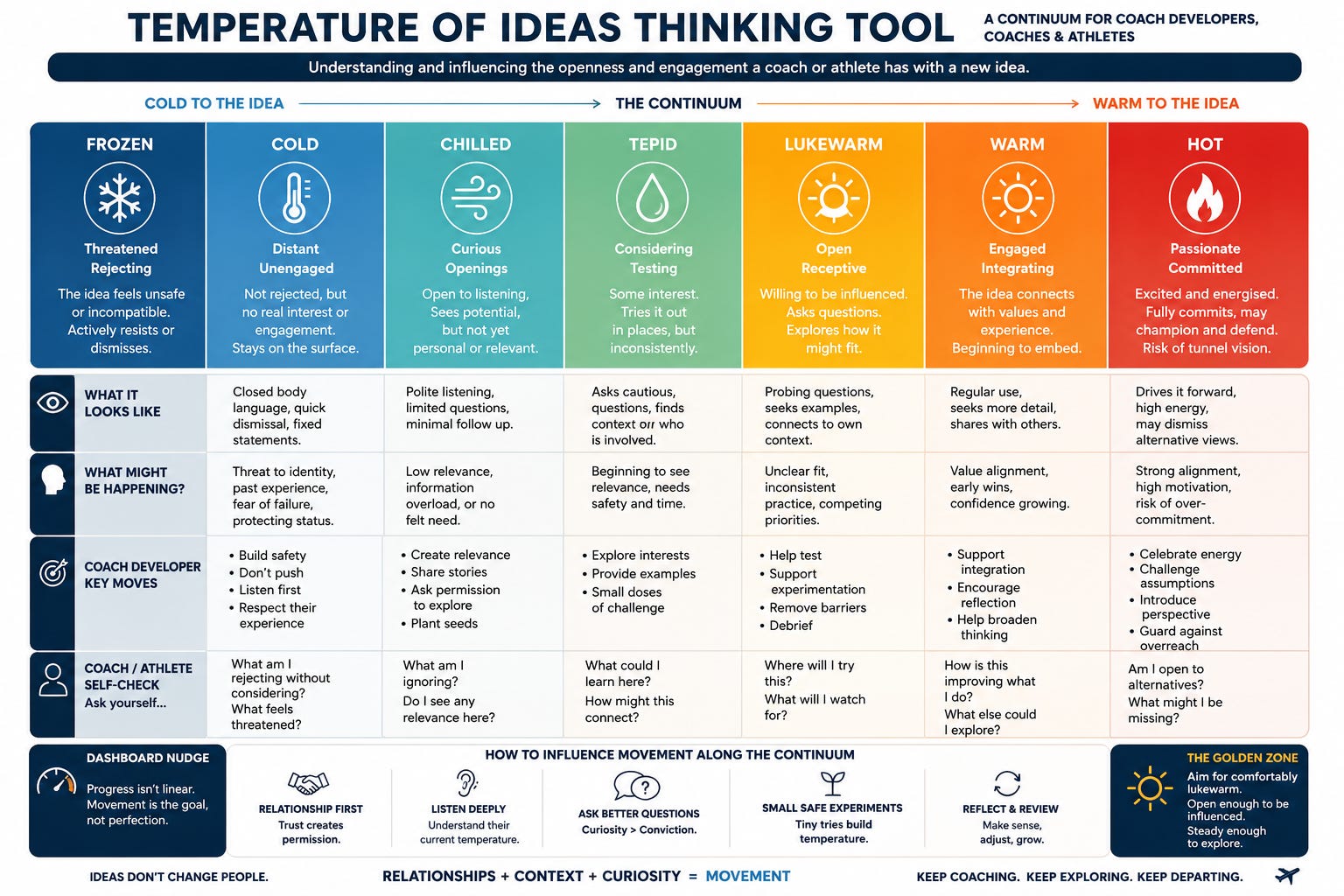
The Temperature of Ideas
What if coaching practice is not just about what we know—but about the temperature at which we hold what we know?
In other words, the issue is not simply knowledge itself, but the emotional, cognitive, and identity-based relationship a coach has with that knowledge.
We might think of this as a spectrum:
Frozen
Cold
Chilled
Tepid
Lukewarm
Warm
Hot
Each “temperature” reflects a different relationship to ideas—specifically the level of openness, threat response, curiosity, and identity investment a coach brings to new thinking.
Importantly, none of these states are inherently good or bad. They are contextual. The real issue is not temperature itself—but being stuck at one temperature for too long.
Because when temperature becomes fixed, learning becomes limited.
Seizing Knowledge: The Necessary First Step
In many coaching environments, there is a natural and necessary desire to “seize” knowledge.
Coaches enter systems, qualifications, environments, and performance pathways where ideas are presented as structured, codified, and often delivered with confidence. There is clarity in this process. There are frameworks, models, and principles.
Over time, coaches take this knowledge and:
Accommodate it into their thinking
Assimilate it into their practice
Apply it in context
This is not the problem. In fact, it is essential.
High-performance environments require a degree of certainty. Athletes need clarity. Sessions need structure. Decisions need to be made under pressure.
The issue begins when seizing becomes settling.
When knowledge stops being a resource and becomes an identity.
Frozen Ideas: When Knowledge Becomes a Threat
At the extreme end of the spectrum is the frozen coach.
This is not simply someone who disagrees with new ideas. It is someone for whom new ideas feel fundamentally incompatible with what they already believe to be true.
Frozen ideas are not processed. They are resisted.
Often this state does not come from ignorance, but from deep investment—years of experience, identity built through practice, and a strong belief in “what works.”
But when a new idea significantly disrupts that identity, it is not evaluated neutrally. It is experienced as a threat.
And when something is experienced as a threat, the natural response is not curiosity—it is closure.
So the idea is not explored.
It is rejected.
Sometimes immediately. Sometimes subtly. But always defensively.
Common expressions of frozen thinking include:
“We tried that before.”
“That doesn’t work in our sport.”
“Our athletes aren’t ready for that.”
These may contain truth—but they can also function as protective mechanisms that preserve existing practice rather than evolve it.
Coaching Nudge (for practitioners)
If you notice yourself rejecting an idea quickly, ask:
“What exactly feels threatened here—my method, my identity, or my certainty?”
That question alone often begins to thaw the freeze.
Cold Ideas: Distance Without Engagement
A step away from frozen is cold.
Cold ideas are not actively rejected, but neither are they meaningfully engaged. They are acknowledged from a distance—observed, discussed, even nodded at—but they do not penetrate practice.
This is where many coaching environments sit comfortably.
Coldness is often mistaken for professionalism: calm, rational, controlled. But beneath that surface, there is little movement.
Nothing really shifts.
Cold environments tend to have lots of knowledge, but limited transformation of that knowledge into behaviour.
Coach Developer Nudge
When working with coaches, consider:
“Are we discussing ideas, or are we changing anything because of them?”
If nothing changes, temperature hasn’t moved—only conversation has.
Chilled Ideas: The First Crack in Certainty
Chilled ideas are where something begins to shift.
Here, a coach might say:
“That’s interesting… I can see how that might apply here.”
Chilled thinking is the first sign of permeability. The idea is not yet adopted, but it is no longer dismissed.
There is a softening of resistance. A small opening.
Crucially, chilled thinking does not require identity abandonment. The coach does not have to give up what they know. Instead, they begin to expand what might also be true.
This is a key developmental space: curiosity begins to compete with certainty.
Coaching Reflection
For coaches working with athletes, this is often the first step in athlete change too.
Ask:
“What is one idea the athlete is not rejecting—but not yet acting on?”
That is your entry point for influence.
Tepid Ideas: Partial Engagement, Inconsistent Application
Tepid is an often overlooked but critical state.
Here, ideas are neither embraced nor resisted. They are partially engaged with, inconsistently applied, and often context-dependent.
A coach in a tepid relationship with an idea might:
Use it in one session but not another
Agree with it conceptually but not operationally
Experiment briefly but without sustained commitment
Tepid engagement is where many innovations go to fade—not because they are rejected, but because they never become important enough to sustain.
It is not that the idea is wrong.
It is that it never becomes embedded.
Coach Developer Nudge
Ask:
“Where is this idea showing up in behaviour—not just conversation?”
If the answer is “nowhere consistently,” you are in tepid territory.
Lukewarm Ideas: The Space of Real Dialogue
Lukewarm is where genuine development begins.
A lukewarm coach is not committed to the idea, but is open to being influenced by it.
There is openness without surrender.
Curiosity without dependency.
At this temperature, coaches begin to ask better questions:
“What if there is something here I’m missing?”
“How might this work in my environment?”
“What would need to be true for this to be useful?”
This is where real dialogue between practice and theory becomes possible.
Lukewarm is not indecision. It is receptive ambiguity—the ability to hold tension between what is known and what is emerging.
Key Developmental Insight
This is often the most productive coaching development space.
Not conviction.
Not rejection.
But exploration without threat.
Warm Ideas: Integration and Identity Alignment
Warm ideas are those that begin to integrate into a coach’s thinking.
They feel right. They connect. They align with values and prior experience.
This is powerful. When ideas align with identity, adoption is fast and confident.
But warmth carries a double edge.
Warm ideas can become confirmation loops.
They reinforce what a coach already believes rather than expanding it.
So the critical question becomes:
“Is this idea expanding thinking—or reinforcing identity?”
Coach Developer Reflection
Be careful not to only “warm confirm” coaches.
Ask:
“Where is this idea challenging you, not just supporting you?”
Hot Ideas: Passion, Intensity, and Narrowing
At the extreme warm end is hot.
Hot ideas energise coaches. They feel urgent, transformative, compelling.
When a coach becomes “hot” for an idea, they often:
Invest deeply
Apply aggressively
Advocate strongly
This can lead to innovation and breakthrough.
But it can also narrow perspective.
Hot ideas can become dominant ideas.
And dominant ideas can reduce tolerance for alternatives.
At this point, coaching shifts from exploration to advocacy.
Athlete Reflection
In athlete-coach environments, this matters greatly.
Ask:
“Is the athlete engaging with the idea—or defending it?”
If it becomes identity, not tool, flexibility is lost.
Extremes: Frozen or Hot—Two Sides of Rigidity
Interestingly, frozen and hot are more similar than they appear.
Both represent rigidity of relationship to ideas, just in opposite directions.
Frozen = rejection through threat
Hot = commitment through dominance
Neither allows flexibility.
Neither supports adaptation.
Both reduce learning capacity over time.
From Temperature to Movement: The Real Goal
The real developmental question is not:
“How do we get coaches to accept more ideas?”
It is:
“How do we help coaches move across the temperature spectrum?”
Because the danger is not any single temperature.
The danger is staying fixed in one state.
Frozen to one truth
Cold to challenge
Hot to one idea
Tepid in disengagement
Coaching development is therefore not persuasion.
It is temperature mobility.
The 20-Year Question
A phrase often heard in coaching is:
“I’ve been coaching for 20 years.”
But the real question is not duration.
It is temperature variation across time.
Have those 20 years involved movement across ideas?
Or repetition of the same temperature cycle?
Because if nothing changes across decades, we are not seeing development.
We are seeing repetition with experience.
And repetition is not expertise.
Creating Conditions for Movement
So how do we help coaches shift temperature?
Not by forcing change.
Not by overwhelming with information.
But by creating conditions where ideas can be:
Safe enough to consider
Challenging enough to matter
Supported enough to try
This is where relationships become central.
Because:
Ideas rarely change coaches.
Other coaches do.
Or environments.
Or conversations.
Or trusted challenges at the right moment.
Coach Developer Responsibilities: Key Nudges
For those working in coach development:
Are you diagnosing temperature before delivering content?
Are you matching your intervention to their openness state?
Are you creating space for chilled curiosity before asking for hot commitment?
Are you confusing conversation with movement?
And most importantly:
Are you helping coaches move temperature, or simply describe it better?
Coach Reflection: Working With Athletes
For coaches working directly with athletes:
Where is your athlete frozen to an idea about themselves?
Where are they cold to feedback that could help them?
Where are they tepid in commitment but warm in intent?
Where are they hot—but potentially narrow in focus?
And ask:
“What temperature shift would unlock performance right now?”
Not more information.
Not more pressure.
But a different relationship with what is already known.
Becoming Lukewarm to Learn More
Perhaps the developmental goal is not to make coaches warmer or colder.
But to make them comfortably lukewarm to uncertainty.
Because lukewarm is where dialogue lives.
Where curiosity survives.
Where identity is not threatened by change.
And where coaching stops being the delivery of what is known—and becomes again the exploration of what might be possible.