
The Disingenuous People Developer…

May disrupt, however, it’s written with positive intent…
One of the more difficult realities of working in coaching, leadership, education, development or high-performance environments is eventually recognising that not everybody who talks about developing people is genuinely interested in people at all.
That sounds cynical.
Perhaps uncomfortable too.
But over time you begin to notice a pattern.
The language is often polished:
“People first.”
“Supporting others.”
“Helping people grow.”
“Creating environments for flourishing.”
“Values-led leadership.”
The words sound right.
The presentations look right.
The LinkedIn posts certainly look right.
But eventually behaviour reveals intention.
And sometimes beneath the language of development sits something far more transactional:
advancement, status, positioning, influence, reputation, visibility, self-preservation.
The uncomfortable truth is that some people do not develop others because they care deeply about people. They develop people because successful people become evidence of their own success.
That is a very different motivation entirely.
The Surface and the Substance
Disingenuous people developers are often difficult to identify initially because externally they can appear incredibly credible.
They know the language of empathy. They understand the vocabulary of vulnerability. They speak fluently about culture, trust, authenticity and belonging.
But relationships with them often leave people strangely depleted.
Why?
Because the relationship was never truly relational.
It was transactional.
People become useful while they provide value:
access, credibility, ideas, labour, emotional energy, networks, loyalty or admiration.
Once the usefulness declines, the warmth often disappears with it.
That is one of the clearest signs.
Genuine people invest in others whether there is advantage attached or not.
Disingenuous people invest selectively where return is likely.
The difference is subtle at first.
But over time it becomes unmistakable.
The Performance of Caring
Modern professional culture increasingly rewards the appearance of virtue.
In leadership spaces especially, there is enormous social value attached to being perceived as:
supportive, empowering, emotionally intelligent and people-centred.
The danger is that care itself can become performative.
Not false entirely — but conditional.
A kind word delivered publicly.
Support offered when visible.
Mentorship that quietly reinforces hierarchy.
Compassion that disappears when someone is no longer strategically useful.
In many industries, particularly high-performance environments, people quickly learn that appearing values-led can become professionally advantageous.
And this is where things become complicated.
Because many of these individuals are not entirely bad people.
Often they started with good intentions.
But ambition changes people if left unchecked.
Gradually identity becomes tied to progression, recognition and status.
The role becomes the self.
The image becomes more important than the substance underneath it.
And somewhere along the way they stop asking:
“Am I helping people?”
And start asking:
“How am I perceived?”
That shift changes everything.
The Currency of Usefulness
One of the hardest lessons for many people is recognising how conditional some professional relationships actually are.
You discover that certain individuals were deeply interested in you only while you occupied a particular role, position or level of influence.
Lose the title, and suddenly the relationship fades.
Calls stop.
Messages slow.
Interest disappears.
That can feel deeply personal.
But often it reveals something important:
the connection was attached more to utility than humanity.
In high-performance environments especially, people can unconsciously become commodities.
Not intentionally perhaps.
Not maliciously always.
But the culture rewards usefulness:
What can this person provide?
What access do they have?
How do they help me move forward?
The danger is when human beings slowly become reduced to professional stepping stones.
And the tragedy is that many individuals caught in this cycle no longer even realise they are doing it.
Success and Sacrifice
There is nothing inherently wrong with ambition.
Nothing wrong with wanting success.
Nothing wrong with wanting recognition, progression or influence.
Most people want to grow professionally.
The issue is not ambition itself.
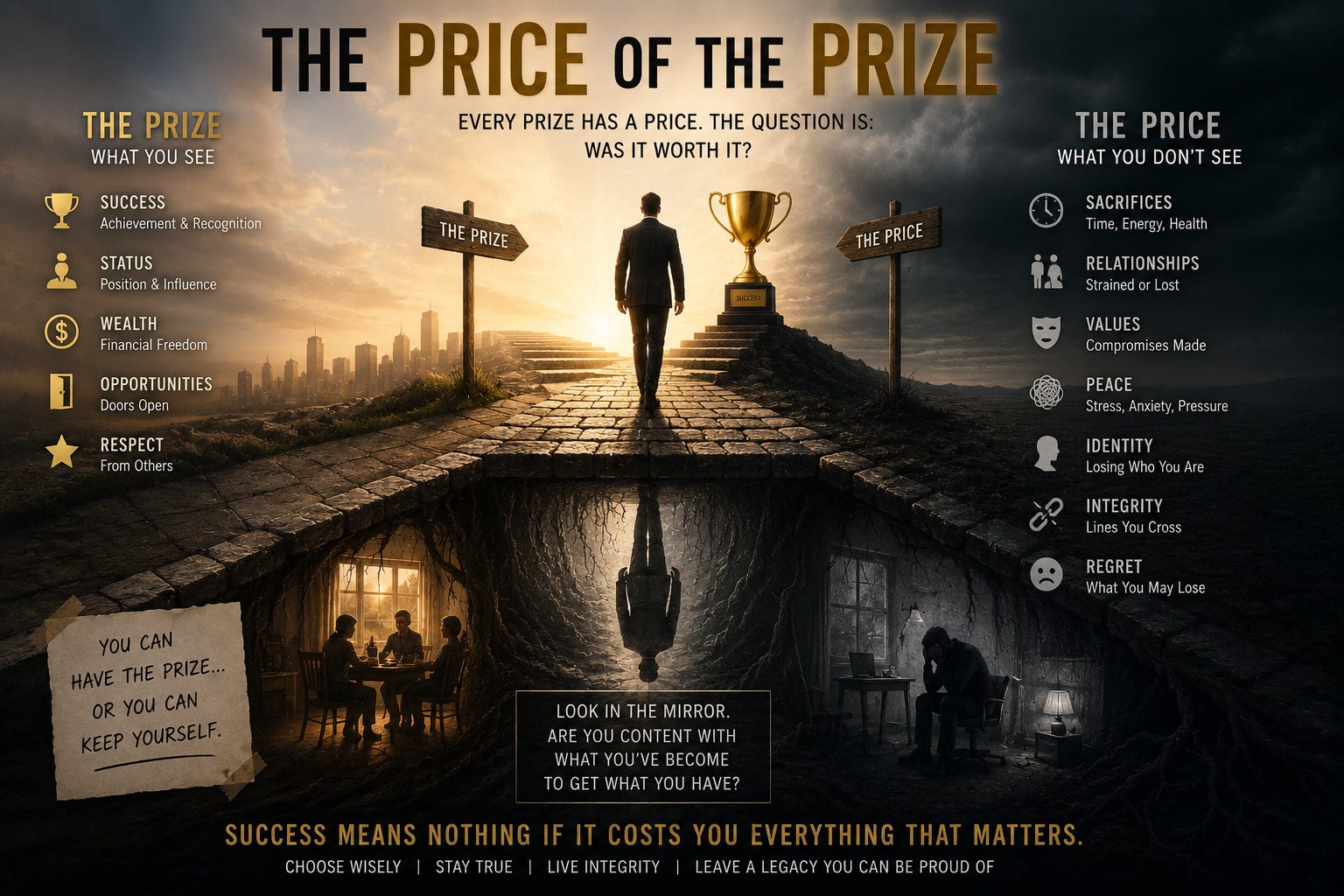
The issue is what gets sacrificed in pursuit of it.
At what point does strategic networking replace genuine connection?
At what point does leadership become self-promotion?
At what point does “developing others” become merely part of personal brand management?
These are uncomfortable questions because they force people to examine not just what they have achieved, but who they have become while achieving it.
Every prize has a price.
Sometimes the price is authenticity.
Sometimes humility.
Sometimes relationships.
Sometimes the slow erosion of empathy itself.
And often the external rewards arrive long before the internal consequences do.
The Freefall Moment
There is an old saying:
“Be careful whose toes you step on today because they may be attached to the backside you may have to kiss tomorrow.”
Crude perhaps.
But wise.
Because careers are rarely linear forever.
Power shifts.
Influence changes.
Roles disappear.
Organisations restructure.
People fall.
And eventually almost everyone experiences some form of freefall:
redundancy, failure, irrelevance, rejection, burnout, loss of status or unexpected vulnerability.
The question then becomes:
what remains when the title disappears?
Who still calls you?
Who genuinely cares?
Who trusts you?
Who respects the way you treated people when you held power?
That is the real measure of leadership.
Not what people say about you when you are successful.
But what remains around you when success becomes uncertain.
Looking in the Mirror
Perhaps the most dangerous thing about disingenuousness is that it rarely arrives suddenly.
It accumulates quietly.
Small compromises.
Small rationalisations.
Small moments where image matters slightly more than integrity.
Until eventually someone wakes up highly successful externally but strangely disconnected internally.
The real challenge is not simply spotting disingenuous people in others.
It is guarding against becoming one ourselves.
Because most people do not consciously decide:
“I am going to become transactional.”
Instead it happens through gradual drift:
pressure, ambition, insecurity, comparison, ego, fear of failure.
That is why self-reflection matters so much.
Not performative reflection.
Not curated vulnerability.
Real reflection.
Looking honestly in the mirror and asking:
Have I stayed human while pursuing success?
Do I value people beyond their usefulness to me?
Have I confused visibility with value?
Am I becoming somebody I would have once struggled to trust?
Those are difficult questions.
But necessary ones.
Because eventually careers end.
Titles fade.
Positions disappear.
And what remains is character.
Not the version performed publicly.
The version lived privately.
That is the person we ultimately have to live with.