
Thoughts, Thinking, and the Dexterity of Coaching Language
A reflection upon a conversation

From time to time, conversations stay with you long after they finish. Not because they arrive with dramatic revelations or scientific certainty, but because they subtly shift the way you begin to notice the world around you.
A recent conversation with Greig Wright did exactly that.
We were catching up as old friends often do, reflecting on coaching, sport, and what we had both been reading recently. We first crossed paths more than twenty years ago at Derbyshire County Cricket Club, and over the years our paths have continued to intersect through coaching and performance environments.
At some point during the conversation, Greig mentioned a book he had been reading and began exploring the distinction between thoughts and thinking. At first glance it sounded almost trivial — surely they are essentially the same thing? But the longer we spoke, the more interesting the distinction became.
And perhaps more importantly, the more relevant it became for coaching.
A thought can appear instantly. It can arrive lightly and without warning. Sometimes almost instinctively.
Thinking, meanwhile, often feels slower. More deliberate. More effortful. It suggests processing, comparison, analysis, interpretation, reflection.
That subtle difference began to linger.
Not necessarily as a scientific conclusion, but as a coaching consideration.
Because coaching, at its heart, is often the art of directing attention.
And language matters.
A great deal.
The difference between asking:
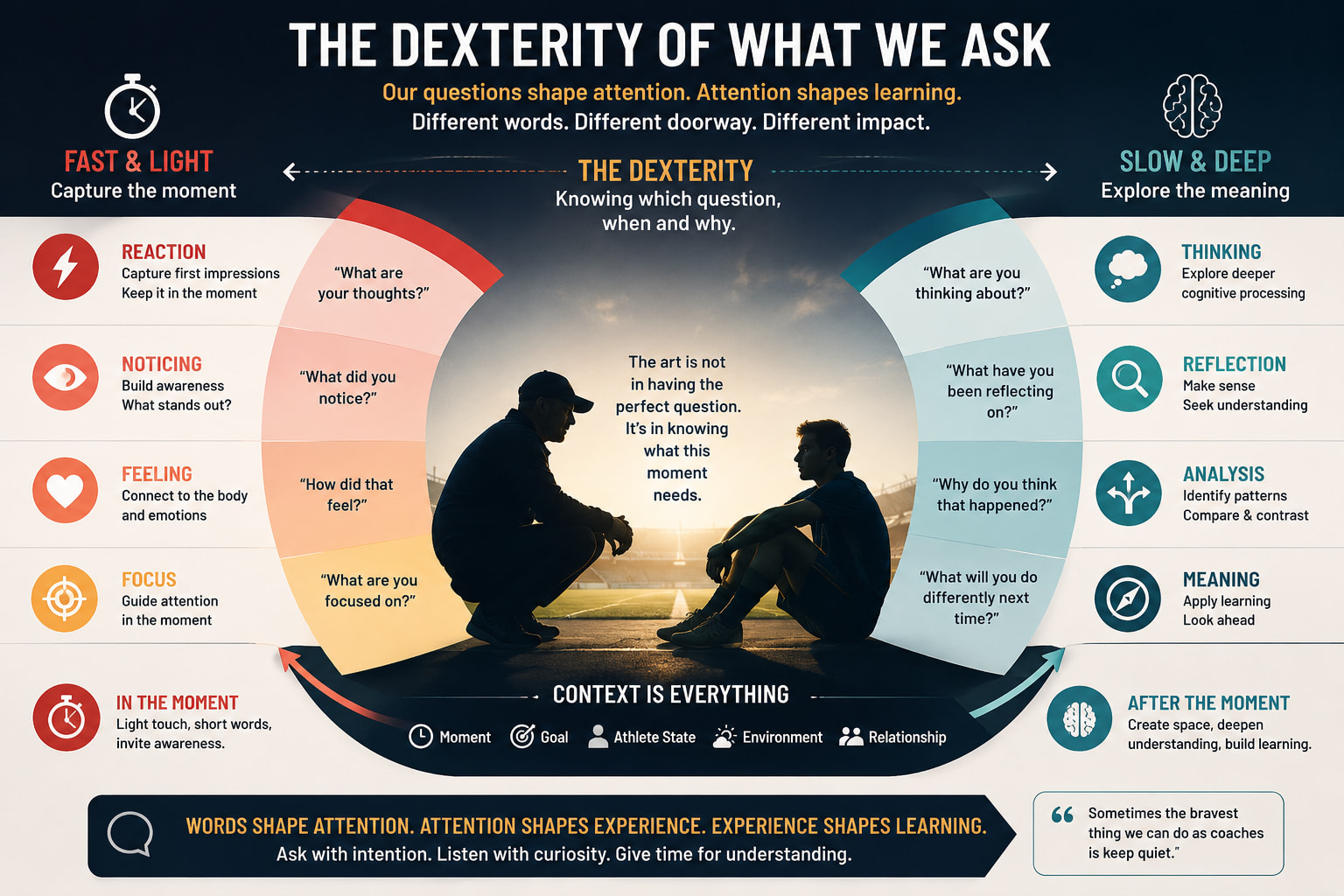
“What are your thoughts?”
and“What are you thinking about?”
may seem incredibly small on paper.
Yet they can create entirely different experiences for the athlete.
One question can invite immediacy and instinct. The other may invite analysis and deeper cognitive searching.
One may keep the athlete close to feeling and perception. The other may shift them toward explanation and rationalisation.
The distinction is subtle, but high-quality coaching often lives within subtlety.
Perhaps this is where coaching begins to move beyond simply asking questions and toward developing a dexterity of language — the ability to shape learning environments through the careful positioning of words.
Not manipulative language.
Not performative language.
But attentive language.
The kind of language that understands timing, emotional state, cognitive load, and the demands of the moment.
A couple of weeks ago, while spending time with performance coaches connected to Paddle UK, another phrase resurfaced repeatedly:
“How does that feel?”
Again, a deceptively simple question.
Yet it points athletes somewhere very different internally.
It does not necessarily ask for analysis. It does not require lengthy explanation. Instead, it invites awareness.
Body position.
Rhythm.
Timing.
Pressure.
Spatial orientation.
Movement quality.
It asks athletes to connect with experience rather than merely describe it.
And maybe that matters more than we realise.
Modern coaching environments can sometimes become heavily dominated by cognitive questioning:
“Why did you do that?”
“What were you thinking?”
“Explain what happened.”
Of course, there are moments where those questions are entirely appropriate. Reflection matters. Understanding matters. Sense-making matters.
But there are also moments when excessive thinking can interfere with performance itself.
Across coaching, skill acquisition, performance psychology, and ecological dynamics, there is increasing appreciation that performers do not always thrive when pulled into conscious explanation during action.
Sometimes movement needs freedom before it needs language.
Sometimes learning needs experiencing before it needs articulating.
Sometimes performance needs flow before it needs analysis.
This does not mean coaches should stop questioning athletes. Far from it.
It may simply mean coaches need to become more aware of what different questions actually do.
A subtle nudge for coaches and coach developers may sit here:
Notice how different questions alter the energy of a conversation.
Notice how some questions speed athletes up while others slow them down.
Notice how certain questions invite certainty while others invite curiosity.
Notice how some questions encourage athletes to search for the “correct answer,” while others allow exploration.
This is perhaps where coaching language becomes less about techniques and more about sensitivity.
Not:
“What is the best question?”
But:
“What does this moment need?”
There is a growing temptation within coach education to search for perfect frameworks, perfect interventions, or perfect questioning models. Yet the reality of coaching is often far messier and more human than tidy diagrams suggest.
The same question asked:
during practice,
during competition,
immediately after failure,
during recovery,
or six hours later over coffee,
may create completely different responses.
Timing shapes meaning.
State shapes meaning.
Relationship shapes meaning.
Even emotional safety shapes meaning.
A coach developer observing coaches in practice might therefore begin to notice not simply whether coaches ask questions, but:
the rhythm of questioning,
the density of questioning,
the emotional tone of questioning,
and the cognitive demand hidden within questioning.
Because sometimes coaches unintentionally overload athletes with language.
Particularly in high-performance environments where there is pressure to demonstrate expertise, intervention can become constant.
Words fill space quickly.
Yet occasionally the most powerful coaching intervention is restraint.
This may be one of the most difficult skills in coaching:
knowing when not to speak.
Silence can feel uncomfortable. Coaches often feel responsible for driving learning continuously. There can be an unconscious fear that quietness appears passive, detached, or ineffective.
But silence is not always absence.
Sometimes silence is permission.
Permission for athletes to search.
Permission for experience to unfold.
Permission for learning to emerge naturally.
There is perhaps another gentle nudge here for coach developers:
How often do we help coaches become comfortable with waiting?
Not waiting passively.
Not disengaging.
But observing attentively enough that intervention becomes intentional rather than automatic.
In many ways, this links beautifully with the concept explored in Thinking, Fast and Slow.
While not directly equivalent, there is an interesting resonance between:
immediate thoughts,
instinctive perception,
felt responses,
and:
slower thinking,
deliberate reasoning,
reflective interpretation.
Perhaps coaching requires access to both.
There are moments where rapid thoughts are useful:
“What did you notice?”
“What stood out?”
“How did that feel?”
These questions can preserve immediacy and connection to action.
Then there are moments where slower thinking becomes valuable:
“What patterns are emerging?”
“What have you been reflecting on recently?”
“What might you do differently next time?”
Both matter.
The art may lie in recognising which doorway is most helpful at a particular moment.
Another subtle shift sits within the language of focus.
Consider the difference between:
“What are you thinking about?”
and“What are you focused on?”
The second question often feels more accessible for performers in action. It directs attention toward intentional cues and performance anchors rather than abstract cognitive processing.
Again, neither is inherently superior.
The value lies in understanding their different effects.
Perhaps exceptional coaches develop an ability to move fluidly between:
feeling,
noticing,
focusing,
reflecting,
analysing,
and simply experiencing.
Not rigidly.
Not mechanically.
But responsively.
This is why coaching remains deeply relational and contextual rather than purely procedural.
And maybe this is where coach development itself becomes interesting.
Coach development is not simply about adding more tools, more models, or more questioning strategies. It may also involve refining awareness:
awareness of language,
awareness of timing,
awareness of attentional demands,
awareness of emotional state,
awareness of when learning needs slowing down,
and awareness of when performance needs freedom.
The smallest shifts in wording can subtly alter what athletes attend to internally.
That does not mean coaches should become paralysed by overthinking every phrase they use. Coaching conversations must still feel natural and authentic.
But it may encourage a greater appreciation for the fidelity and dexterity of communication.
Because words do more than transfer information.
Words shape attention.
Attention shapes experience.
And experience shapes learning.
Perhaps that is why this conversation with Greig stayed with me.
Not because it produced definitive answers.
But because it sharpened awareness.
And maybe that is one of the enduring qualities of meaningful coaching conversations: they do not always conclude neatly. Instead, they continue unfolding quietly in the background, influencing how we observe, listen, question, and wait.
Maybe the real coaching craft is not simply learning more questions.
Maybe it is becoming more thoughtful about what different questions invite.