
What Game Are We Playing?
Board Games, Leadership and the Hidden Rules of Performance

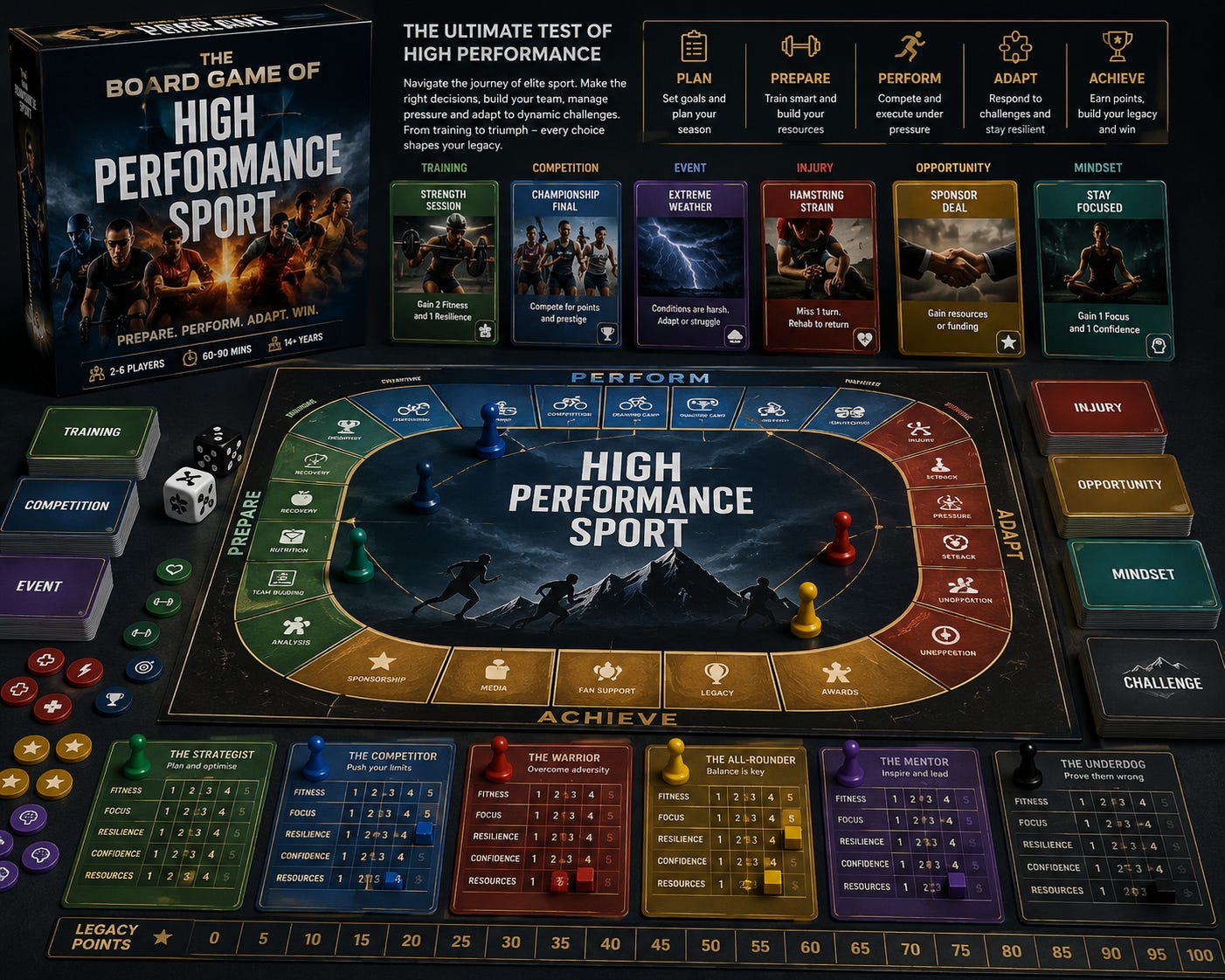
One of the enduring challenges of leadership is that situations rarely arrive with clear instructions. Coaches, managers, performance directors and leaders are constantly required to make decisions in environments that are complex, dynamic and uncertain. We are expected to act, often quickly, and yet the quality of our actions depends largely on how well we understand the situation in front of us.
Over time, I have become increasingly interested in a deceptively simple question:
What game are we playing right now?
At first glance it seems an unusual question. Leadership is not a board game, and performance sport is certainly more complicated than a collection of pieces, cards and dice. Yet there is something powerful about the comparison. Every board game has an objective, a set of rules, constraints, opportunities and consequences. Success depends not only on playing well but on understanding the nature of the game itself.
Perhaps one of the reasons leaders sometimes struggle is that they unknowingly apply the logic of one game to a situation that requires a completely different approach. We attempt to solve an investigative problem with an investment mindset. We approach a developmental challenge as though it were a resource issue. We search for certainty in situations where uncertainty is an unavoidable feature of the landscape.
The result is often frustration, not because people lack capability, but because they are playing the wrong game.
This idea became clearer to me when reflecting on a collection of traditional board games and what each might teach us about leadership and performance.
Take Pick-Up Sticks, for example. It is a simple game in which a collection of coloured sticks are dropped into a tangled pile. Players must carefully remove individual sticks without disturbing the others. The challenge is not strength, speed or aggression. It is precision.
Many mature performance environments feel remarkably similar. Early in a programme, change can be relatively straightforward. New structures can be introduced, new staff can be appointed and new processes established. However, as organisations mature, everything becomes interconnected. A change to one area influences several others. Altering a training process affects confidence. Confidence affects relationships. Relationships affect communication. Communication affects culture.
In such circumstances leadership becomes less about adding more and more initiatives and more about understanding what can be carefully removed. The question shifts from "What else do we need?" to "What is getting in the way?" Pick-Up Sticks reminds us that sometimes progress comes through thoughtful subtraction rather than endless addition.
At other times leadership resembles a game of Cluedo. Something has happened, but the cause is unclear. Results have declined. Standards have slipped. An athlete appears disengaged. Team dynamics have changed.
The temptation in these moments is to move immediately towards solutions. Yet Cluedo teaches a valuable discipline: investigate before intervening.
The objective of the game is not to guess but to understand. What happened? Where did it happen? Who was involved? What factors contributed to the outcome?
The best coaches often display the mindset of detectives rather than mechanics. They are curious before they are certain. They gather evidence before drawing conclusions. They understand that many performance problems are symptoms rather than causes.
In a world that often rewards speed, Cluedo reminds us of the value of patience and diagnosis.
Then there is Monopoly, perhaps one of the most recognisable board games in the world. While many people think of it as a game about property, it is really a game about resource allocation. Every decision involves risk. Every investment creates an opportunity cost. Resources are finite and choices matter.
Leadership in high-performance sport is often remarkably similar. Time, energy, attention, staff capacity and financial resources are all limited. Leaders are continually making decisions about where to invest and where not to invest.
One of the realities of leadership is that saying yes to one thing inevitably means saying no to something else. The challenge is not identifying opportunities; opportunities are usually abundant. The challenge is deciding which opportunities deserve investment and which should be left alone.
Monopoly reminds us that strategy is often less about ambition and more about disciplined prioritisation.
Of course, not every situation allows for complete information. In fact, many of the most significant decisions in sport are made with considerable uncertainty. This is where the lessons of Poker become relevant.
In Poker, players never possess all the information they would like. They cannot see every card. They cannot fully understand the intentions of others. Yet they must still decide.
The same is true for coaches and leaders. Recruitment decisions, selection decisions, investment decisions and competition strategies are all shaped by uncertainty. Waiting for complete certainty is often unrealistic because certainty rarely arrives.
The most effective leaders learn to make sound decisions despite ambiguity. They become comfortable acting with incomplete information while remaining open to adjusting their thinking as new evidence emerges. Success is not about always being right. It is about consistently making the best decision possible with the information available at the time.
Another useful metaphor comes from Blackjack. The objective is not to accumulate endlessly but to get close to the target without exceeding it. Go too far and you lose.
This lesson feels increasingly relevant in modern performance environments where more is often viewed as better. More training. More data. More analysis. More feedback. More pressure.
Yet performance is rarely maximised through endless accumulation. Athletes require challenge, but too much challenge creates burnout. Teams require accountability, but excessive accountability can undermine trust. Development requires stretch, but too much stretch creates anxiety.
The art lies in finding the optimal point between too little and too much. Not maximum, but enough.
Dominoes offers another perspective. It reminds us that outcomes are often shaped by chains of interconnected events. Small actions create larger consequences. A conversation influences trust. Trust influences communication. Communication influences collaboration. Collaboration influences performance.
Leaders are often drawn towards large-scale interventions because they appear significant. Yet some of the most powerful changes begin with identifying the first domino. The small adjustment that creates momentum. The subtle behaviour that shifts culture. The seemingly insignificant decision that changes a trajectory.
Finally, there is Snakes and Ladders. If there is a game that captures the reality of athlete development, leadership growth and organisational progress, this may be it.
The journey is rarely linear. Progress is followed by setbacks. Breakthroughs are interrupted by challenges. Success is often accompanied by periods of frustration and uncertainty.
Many people become discouraged because they expect growth to be predictable. Yet development has always involved snakes and ladders. The challenge is not avoiding every setback. The challenge is continuing to climb after encountering one.
When viewed together, these games reveal something important. Effective leadership is not simply about possessing a toolkit of solutions. It is about understanding the nature of the challenge before selecting the tool.
Some situations require the precision of Pick-Up Sticks. Others require the curiosity of Cluedo. Some demand the investment mindset of Monopoly, while others call for the calculated judgement of Poker or Blackjack.
Perhaps this is one of the hidden skills of great leadership. The ability to pause, observe and ask:
What game are we playing right now?
And perhaps there is an equally important follow-up question.
Every game has rules. Some are written. Others are unwritten. Some help people succeed. Others quietly constrain behaviour without anyone noticing.
Before deciding what to do next, it may be worth asking:
What game are we playing?
And what are the rules that are shaping the way we play it?
Because once we understand the game and recognise the rules, better decisions often follow.