
What Gets Developed in Coach Development?

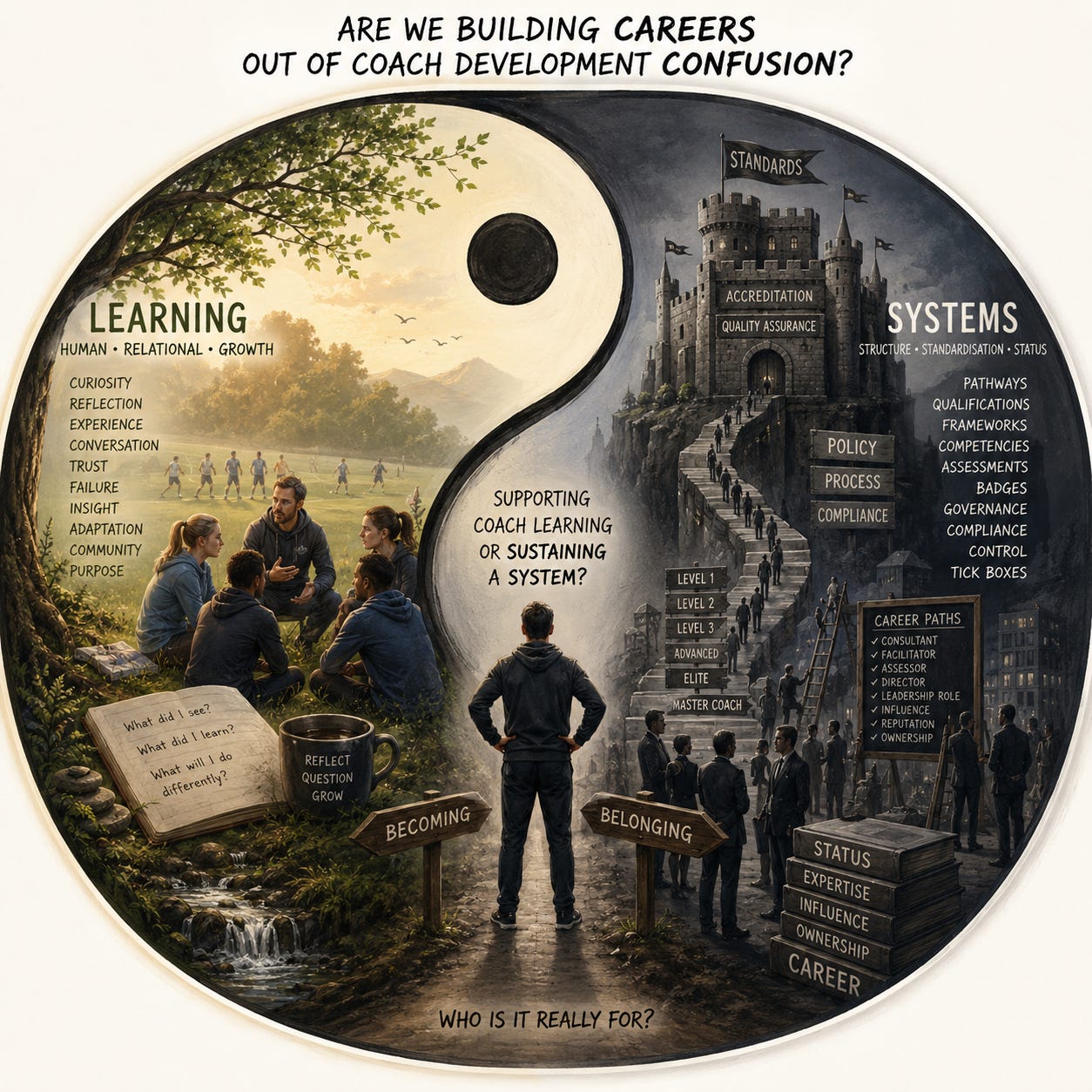
After all these years, the question still lingers: what is coach development? More importantly, what actually gets developed in coach development? And is there really a difference between coach education and coach development?
Perhaps the confusion itself tells us something important. If those of us involved in coaching, coach education, and coach development struggle to articulate the distinctions clearly, then it is hardly surprising that sporting organisations begin to question what they are investing in. When budgets tighten, ambiguity becomes vulnerable. People rarely cut what they clearly understand.
And those of us who have worked in this space have to share accountability for that confusion.
The irony is that perhaps we have become clearer about coach learning than we have about coach development or coach education. Coach learning feels like the broader landscape — the overarching paradigm. It is the lifelong, deeply personal process through which coaches make sense of experiences, relationships, successes, failures, observations, conversations, and reflection.
Coach learning is not owned by a programme.
It is not confined to a course.
It is not completed when a certificate is awarded.
Coach learning is the ongoing journey of becoming.
Coach development and coach education, meanwhile, are often what organisations offer. They are structures, interventions, programmes, workshops, qualifications, mentoring schemes, communities of practice, and formal systems designed to support coaches. They are attempts to facilitate learning.
But there is an important tension here.
The moment we create a programme, we create a beginning and an end. We create structure. We create timelines, outcomes, checkpoints, competencies, and assessment criteria. Even when we speak of “bespoke” provision, the very existence of a programme subtly shapes behaviour toward conformity.
So how individualised can it truly be?
The clue may already exist in another part of sport. We readily accept that athletes need individual development plans because athletes are individuals. Different histories. Different motivations. Different rates of adaptation. Different aspirations.
So why would coaches be any different?
And yet many systems still attempt to place coaches into standardised pathways:
beginner, intermediate, advanced, elite.
Linear.
Sequential.
Predictable.
There is reassurance in pathways. Organisations like them because pathways create order. They help governance, funding, safeguarding, quality assurance, and consistency. They provide visible structures that can be explained to stakeholders.
But human learning rarely behaves so neatly.
A coach may be technically advanced yet emotionally inexperienced. Another may have remarkable relational intelligence yet limited tactical understanding. One coach may thrive through dialogue and reflection; another through experimentation and observation. Some learn through failure. Some through mentorship. Some through crisis.
Learning is messy.
And perhaps that is where the discomfort begins.
Because the more we try to solve complexity through increasingly elaborate programmes, the more we risk creating systems so complex that they lose sight of the human being at the centre of them. There is a strange paradox emerging in modern coach development:
In trying to personalise everything, we can accidentally over-engineer the experience.
Many of us have designed programmes with good intentions. Some worked beautifully. Some did not. But eventually there comes a moment of reflection where you quietly ask:
Are we trying to meet the needs of coaches through an impossible systems-based approach?
Perhaps coach education and coach development are not the same thing at all.
Coach education, at least traditionally, often refers to formalised instruction. It is curriculum-based. It tends to lead toward qualifications or certification. It is aligned to governing bodies, standards, and organisational expectations. In many ways, coach education exists to establish minimum effective practice. It protects athletes. It reduces harm. It supports safeguarding, wellbeing, and technical competence.
And these things matter enormously.
Without some level of educational structure, sport risks inconsistency and unsafe practice. Educational systems provide foundational building blocks. They create shared language and understanding. They matter particularly for novice coaches who need guidance, clarity, and support.
But development feels different.
Development is less about acquiring content and more about becoming someone.
It is identity work.
It is emotional work.
It is relational work.
Development happens in the uncomfortable spaces between certainty and doubt. It emerges through conversations, experiences, reflection, mistakes, challenge, trust, observation, and time. Development cannot simply be delivered; it must be encountered.
Education may provide the map.
Development is what happens when the coach starts walking.
And perhaps one of the deeper dangers is when educational systems become castles rather than catalysts.
Sometimes systems unintentionally begin protecting themselves. Qualifications create hierarchies. Pathways create gatekeepers. Expertise becomes associated with status and ownership. Careers, influence, and institutional power can quietly attach themselves to educational structures.
The risk is that the system begins serving itself rather than serving learning.
We can end up building educational castles instead of learning communities.
Castles create walls.
Learning requires openness.
The question then becomes not “How do we build better programmes?” but perhaps:
“How do we create environments where coaches can genuinely learn?”
That may involve programmes, but it also requires humility. It requires recognising that learning cannot always be controlled, sequenced, or standardised. Some of the most powerful coach learning moments happen accidentally: a conversation after training, a failure in competition, observing another coach, being challenged by an athlete, becoming a parent, suffering loss, changing environments, or simply gaining perspective through time.
No curriculum fully captures that.
Perhaps coach development is less about delivering knowledge and more about cultivating awareness.
Awareness of self.
Awareness of others.
Awareness of context.
Awareness of the consequences of our behaviour.
And maybe the future of coach development lies not in bigger systems but in better questions.
Not:
“What course should this coach attend next?”
But:
“What does this coach need right now?”
Not:
“How do we move coaches along a pathway?”
But:
“How do we help coaches continue becoming?”
Because in the end, coaching itself is not linear. It is relational, adaptive, emotional, and deeply human.
Maybe coach learning is the river.
Coach education is one bridge across it.
Coach development is the ongoing journey of learning how to navigate the water.
We may just need a coach development positioning statement but the question is who writes it who’s involved and who is it fundamentally from and why?