
When Measures Become Targets… Be Aware and Mindful

Reflections on Metrics, Goals, and Unintended Consequences
In modern organisations, across business, education, and sport, there is a pervasive drive to measure. We measure progress, performance, and professional development. Numbers offer a sense of clarity and objectivity in an otherwise complex world. In coaching, for instance, it is common to track how many coaches have attended professional development events, acquired certain qualifications, or achieved chartered status. These metrics are often intended to capture the growth of the coaching workforce, the development of expertise, or the maturity of professional standards.
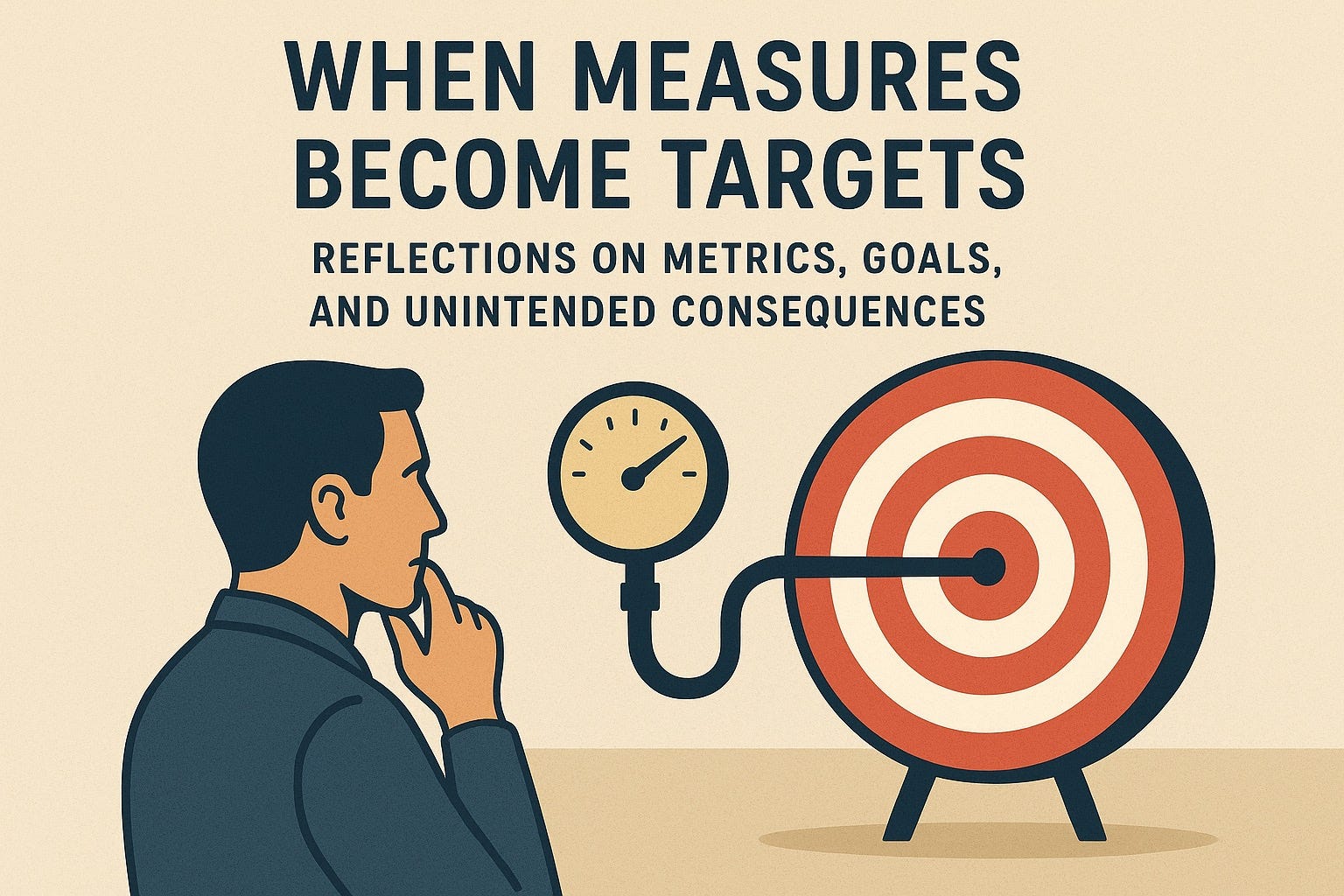
Yet, as useful as measurements are, there lies a subtle but profound danger in the way they are often used. The central question, which has become a topic of reflection across multiple domains, is:
what happens when a measure stops being a tool for insight and instead becomes the goal itself?
This is the essence of a phenomenon famously captured by Goodhart’s Law:
“When a measure becomes a target, it ceases to be a good measure.”
Once a number is no longer just a way of understanding progress but instead defines what success looks like, the system begins to shift. Behaviours, resource allocation, and decision-making adapt to hit the target — often in ways that obscure or undermine the original purpose.
Theoretical Foundations: Understanding the Risk
Goodhart’s Law originated in economics, where Charles Goodhart observed that using economic indicators as control mechanisms caused them to lose predictive power. The logic, however, applies far beyond monetary policy. Once a metric is elevated from observation to prescription, the very act of pursuing it changes the system. Individuals and organisations respond strategically to the measure itself rather than to the underlying goal.
Building on this, social scientist Donald Campbell articulated a more general principle:
“The more any quantitative social indicator is used for decision-making, the more it will be subject to corruption pressures and distort the processes it is intended to monitor.”
Campbell’s Law highlights a fundamental tension: when measures influence decisions, they cease to be neutral reflections of reality. They actively shape reality — often in unintended ways.
Even earlier, Robert K. Merton explored the idea of unintended consequences in social action, noting that deliberate attempts to control a system often produce effects far beyond what was anticipated. Applied to modern organisations, this suggests that targets, however well-intentioned, inevitably create incentives that were not fully considered.
Finally, thinking in terms of complex adaptive systems deepens our understanding. Organisations are not linear machines but networks of interdependent actors, resources, and processes. Introducing a target is not neutral: it reorganises the system. People adapt, often in ingenious ways, to meet the target, sometimes in ways that conflict with the original purpose. In this sense, the problem is not that people are dishonest or lazy — it is that the system itself encourages behaviour that serves the metric rather than the underlying goal.
Conceptual Examples in Coaching
Coaching provides a useful lens for exploring this phenomenon. Consider a hypothetical scenario: a national programme aims to grow the professional coaching workforce. At a given point, 50 coaches hold chartered professional status. To demonstrate growth, the organisation sets a target of 200 chartered coaches within five years. On the surface, this seems straightforward: the measure is “number of chartered coaches,” and the target is 200.
However, several subtle shifts begin to occur once the target is set. First, behaviours are influenced by the target itself. Coaches and managers may prioritise activities that are most likely to increase the count, even if those activities do not meaningfully develop expertise or improve the quality of coaching. Resources are allocated to initiatives that boost numbers rather than depth. Selection processes might implicitly favour candidates who can be quickly certified rather than those who may require more development but ultimately have higher long-term impact.
Second, the measure ceases to function purely as a reflection of coaching quality and becomes a proxy for organisational success. Achieving the number of chartered coaches becomes more important than asking whether those coaches are actually delivering better outcomes for athletes. In short, the measure has transformed into a target, and the system bends itself to satisfy the metric, potentially at the expense of the goal.
Importantly, these effects are rarely malicious. Most actors are motivated by good intentions. The challenge arises from structural incentives: when success is defined by the metric, the easiest or most visible path to success will dominate, regardless of whether it aligns with the original purpose.
Risks of Measure-Target Confusion
The phenomenon of measure-target confusion has several interrelated risks:
Gaming the System When numbers become targets, people find ways to optimise the metric, sometimes in superficial or unintended ways. In coaching, this could mean prioritising those easiest to certify, focusing on attendance rather than learning, or investing in tick-box compliance rather than genuine professional growth.
Tunnel Vision A singular focus on one measure can obscure other important aspects of performance or development. For example, tracking only the number of chartered coaches may neglect mentoring quality, impact on athlete performance, or long-term retention. Unmeasured areas of importance often suffer when attention is monopolised by the target.
Short-Termism Targets often have deadlines, which encourages short-term actions that improve immediate metrics rather than sustainable long-term outcomes. This might manifest as fast-tracking coaching programmes to hit numerical targets while ignoring whether the accelerated approach truly develops high-quality coaching skills.
Biases in Selection and Investment Targets can subtly influence who is selected for opportunities and how resources are allocated. If the emphasis is on meeting a numeric goal, decision-makers may unintentionally favour candidates or initiatives that look good on paper but do not necessarily enhance the quality of the workforce.
Erosion of Trust and Motivation Over time, excessive focus on metrics can demotivate those committed to meaningful impact. When the system signals that numbers matter more than outcomes, intrinsic motivation to improve coaching quality may be undermined. People learn to work for the metric rather than for the mission.
Principles for Better Measurement
Despite these risks, measures and targets remain essential tools. The challenge is not to abandon them but to use them wisely. Several guiding principles can help:
Clarify the True Goal Before setting any target, organisations should ask: what is the underlying goal? Numbers alone are rarely the ultimate objective; they are proxies for impact. Understanding the purpose allows measures to serve insight rather than control.
Use Multiple Indicators Reliance on a single measure creates distortion risk. Multiple, complementary indicators allow triangulation, reduce gaming opportunities, and provide a richer picture of progress. For example, alongside counting chartered coaches, one could measure coaching impact on athlete development, peer mentoring contributions, or qualitative feedback from participants.
Treat Measures as Feedback, Not Rules Metrics should inform decisions and reflection rather than dictate them. When measures are treated as diagnostic tools, the system retains flexibility and adaptability.
Regular Review and Reflection Measures are not static. Organisations should routinely ask: is this measure still meaningful? Are behaviours changing in ways that undermine the goal? Regular review allows recalibration before unintended consequences become entrenched.
Foster Systemic Thinking Understanding the organisation as a complex system encourages attention to interactions and side effects. Targets should be introduced with awareness of potential ripple effects and adaptive behaviours, not as isolated endpoints.
A Reflective Approach
The challenge of measure-target confusion is not purely technical; it is deeply cultural and reflective. It asks organisations, leaders, and practitioners to pause and consider: are we chasing numbers or real impact? Are our incentives aligned with our purpose, or with appearances of progress?
In coaching, this reflection might manifest as questions like:
Are we developing coaches who make a meaningful difference, or just those who can quickly tick boxes?
Are our measures capturing the essence of expertise, or just the countable outcomes?
How do we balance accountability with learning, ambition with sustainability?
These questions resist easy answers, but they are essential for healthy organisational practice. The moment a measure dominates decision-making, the system starts to bend. Awareness of this dynamic — of Goodhart’s Law and its cousins — is the first step toward a more thoughtful approach to targets, metrics, and impact.
Conclusion
Metrics are powerful tools, offering clarity, structure, and accountability. Targets can motivate action, focus effort, and signal ambition. Yet, the same tools carry risks if uncritically applied. When measures become targets, they cease to be neutral reflections of reality and begin to shape the system in unforeseen ways.
In coaching and beyond, the challenge is to balance measurement with mindfulness: to use numbers as guides rather than definitions of success, to triangulate multiple perspectives, and to remain alert to unintended consequences. By doing so, organisations can harness the power of measurement while protecting the integrity of the underlying goals they seek to achieve.
Ultimately, the lesson is simple in principle but in practice: measure, yes — but never let the measure define what matters.